
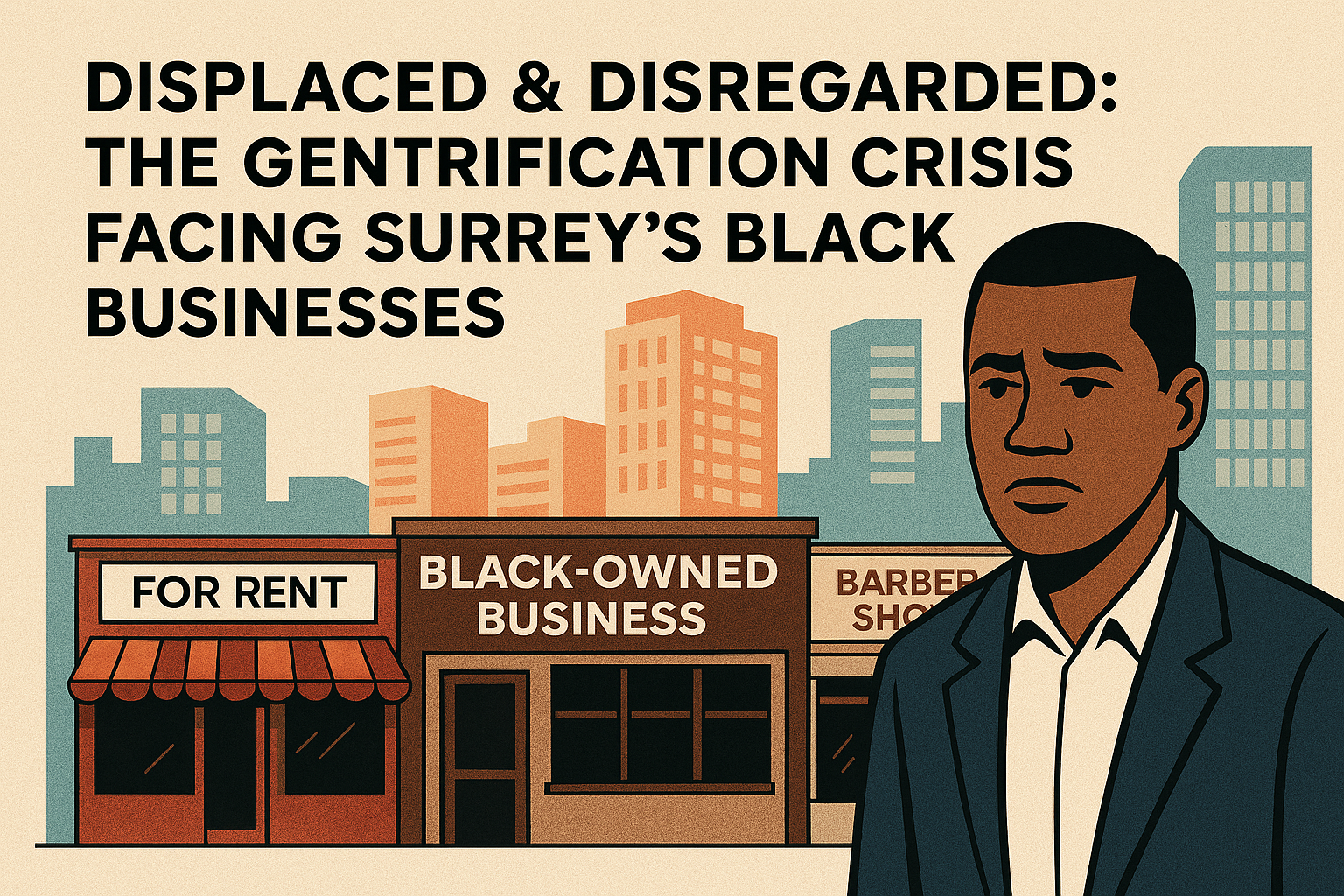

Displaced & Disregarded: The Gentrification Crisis Facing Surrey’s Black Businesses
A Commentary on Economic Displacement and the Urgent Need for Municipal Action
Surrey’s skyline is transforming at breakneck speed. Glass towers, luxury condos, and high‑density developments dominate the horizon, celebrated as symbols of “progress” and economic growth. But beneath the marketing language and ceremonial ribbon‑cuttings lies a harsh truth the city refuses to acknowledge:
Black businesses are being pushed out, erased, and treated as expendable — and City Hall has yet to respond.
Over the past three years, Black entrepreneurs in Surrey have faced a mounting crisis of displacement. No targeted grants. No protection from redevelopment. No municipal strategies to prevent economic erasure. Just rising rents, redevelopment notices, and a message made painfully clear:
If you’re a big corporation, you’re valued. If you’re a small Black‑owned business, you’re on your own.
The Reality: Surrey’s Black Business Community Is Being Erased
Surrey is home to British Columbia’s largest Black population; a thriving community that contributes richly to the cultural and economic life of the city. Yet while Surrey proudly highlights the addition of 1,000+ new businesses each year in its economic reports, Black‑owned shops, salons, restaurants, and service providers are quietly disappearing.
The reasons are painfully consistent:
- Landlords selling to developers.
- Commercial rents doubling or tripling overnight.
- Leases terminated because “redevelopment is coming.”
- New commercial units priced far beyond community affordability.
And through it all? Silence from the City of Surrey.
No emergency supports. No anti‑displacement policies. No targeted funding. No infrastructure or programming to help Black entrepreneurs survive the transformation of the neighbourhoods they helped build.
Surrey celebrates economic growth…. but whose growth is being protected?
The Pattern: Luxury Development Over Community Commerce
The cycle is predictable:
- A developer identifies an aging commercial block.
- They promise “revitalization,” mixed‑use towers, ground‑floor retail, and increased tax revenue.
- The City approves the proposal.
- Existing tenants, often long‑standing Black business owners, receive eviction notices or unaffordable rent increases.
- The new building opens.
- Corporate chains fill the retail units: Starbucks, national pharmacies, boutique fitness studios.
- The barbershop serving three generations? Gone.
- The Caribbean restaurant that was a cultural hub? Replaced by a franchise smoothie bar.
This isn’t revitalization — it’s displacement dressed up as progress.
“If You’re Big Business, You’re Gold. If You’re Not? You’re No Business.”
Surrey’s economic development priorities are clear, and they are not aligned with community preservation.
Look at where municipal investment, incentives, and partnerships flow:
- Major retail chains
- National franchises
- Large commercial developers
- Big‑box and high‑growth corporate tenants
Meanwhile, Black business owners, many operating with thin margins and serving essential community needs, are treated as collateral damage when rent spikes or redevelopment notices arrive.
The city bends over backwards to attract a Target, a Tesla dealership, or another multinational brand. But a Black‑owned catering company losing its rented kitchen space to a condo tower?
That’s dismissed as “market forces.”
This isn’t just economics. It’s prioritization.
And Surrey’s priorities leave no room for Black entrepreneurship to survive, let alone thrive.
Three Years. Zero Support.
Here’s what the City of Surrey has not done in the past three years:
- No targeted relief fund to support Black businesses impacted by redevelopment
- No commercial rent stabilization measures in gentrifying neighbourhoods
- No first‑right‑of‑return guarantees for displaced tenants in new developments
- No dedicated municipal funding for a Black business association or Black entrepreneurship support
- No anti‑displacement task force to study or mitigate the crisis
Meanwhile, other Canadian cities are moving forward with policies that protect legacy businesses and prevent economic erasure. Surrey, one of the most diverse cities in the country, refuses to act.
What Black Business Owners Are Actually Facing
This crisis is not abstract. It’s happening every day.
Rent hikes:
A Black‑owned hair salon or beauty supply store receives a lease renewal with a 200%–250% increase. They can’t absorb the cost. They shut down.
Rezoning displacement:
A beloved restaurant serving Caribbean, African, or Afro‑diasporic cuisine is given six months’ notice before demolition. They search desperately for a new space but find commercial units priced far beyond their reach.
Broken development promises:
Developers promise “affordable retail” and “space for local business.” When the building opens, the rent is $8,000 a month for 800 square feet — a clear barrier designed to attract chains, not community owners.
Zero consultation:
Rezoning moves forward without a single conversation with affected Black business owners. Public hearings are scheduled at inaccessible times. Communities most impacted are shut out of the decision‑making process.
This is not progress. It is economic violence — sanctioned by municipal inaction.
Why This Matters: The Cost of Erasure
Black businesses are more than commercial entities. They are:
- Community anchors
- Cultural touchstones
- Training grounds for youth
- Sources of economic mobility
- Safe social spaces
- Preservers of heritage and identity
When a Black barbershop closes, an entire social ecosystem collapses.
When a Black restaurant disappears, a cultural space for belonging disappears with it.
Gentrification doesn’t create opportunity for Black entrepreneurs — it eliminates it.
Those gleaming new towers? The retail rates are beyond reach.
Those “revitalized” neighbourhoods? Designed for corporate tenants, not community-rooted businesses.
This is not economic development.
It is economic cleansing.
What Needs to Happen Now
If Surrey is serious about equity, not just in reports or ceremonies, but in practice, then five actions are urgently needed:
- Commercial Rent Stabilization
Cap rent increases in redevelopment zones to prevent predatory hikes. - First Right of Return
Guarantee displaced tenants the right to return to new units at affordable rates. - Displacement Relief Fund
Provide grants (not loans) to Black businesses facing forced closure. - Dedicated Black Business Support
Fund organizations already doing the work and support the creation of a long-term Black Business Hub. - Mandatory Business Consultation
Require developers to meet with existing tenants and create mitigation plans before rezoning is approved.
Nothing changes unless we demand it.
This Isn’t Just Surrey’s Problem — It’s a Warning
What is happening in Surrey mirrors a pattern across Metro Vancouver, across Canada, and across North America:
Black communities build.
Gentrification takes.
Cities call it progress.
But gentrification is not inevitable.
It is a policy choice, and Surrey has chosen developers over communities.
It’s time to force a different choice.
What You Can Do Right Now
If you’re a Black business owner in Surrey:
- Document everything: rent increases, eviction notices, landlord communications
- Connect with other displaced or threatened businesses
- Join collective advocacy efforts
If you’re a Surrey resident:
- Support Black-owned businesses – Support small businesses while they’re still here
- Attend city council meetings
- Demand anti‑displacement action
- Share this article
If you’re an elected official or candidate:
Do better. Right now, your silence is part of the problem.
The Bottom Line
Surrey’s Black businesses are being displaced, disregarded, and erased.
The city has made its priorities clear:
If you’re big business, you’re welcome. If you’re not, you’re invisible.
This isn’t progress — it’s injustice wrapped in development blueprints.
The question is not whether gentrification is happening.
It is.
The question is whether we’re willing to fight for a future where Black businesses have the right not just to exist, but to stay.
If we don’t act, Surrey will lose an entire generation of Black businesses, and the city will be culturally, socially, and economically poorer for it.
Now is the time to demand better.